
What Is 3-Way Betting in Cricket? Meaning, Examples & Guide for Indian Users
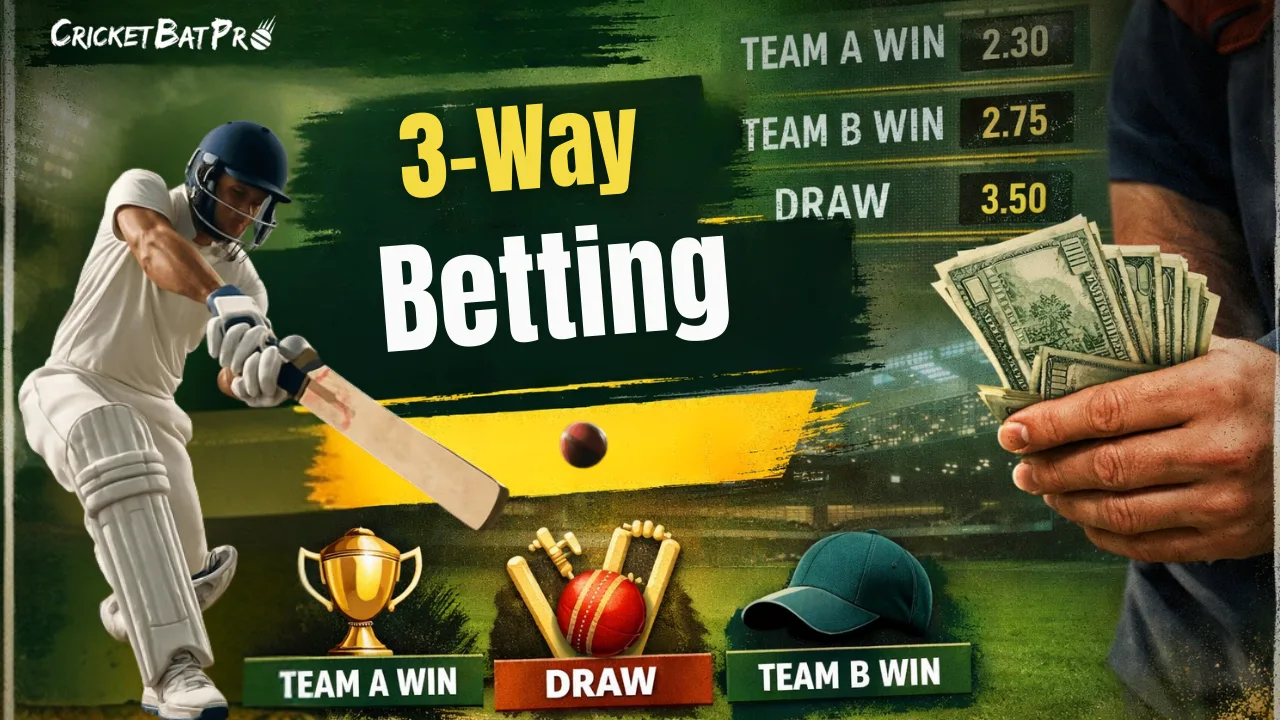
Cricket in India is not just a sport; it is followed session by session, ball by ball, pitch report by pitch report. And unlike many other sports, cricket, especially Test cricket, does not always produce a winner. That is exactly where 3-way betting in cricket becomes relevant.
So, what is 3-way betting in cricket? It is a betting format where you choose from three possible outcomes:
- Team A wins
- Team B wins
- The match ends in a draw
This guide explains the 3-way betting meaning in cricket, how this market works, where Indian users usually find it, why draws happen, and how bettors approach this format more strategically.
What Is 3-Way Betting in Cricket?
In simple words, 3 way betting in cricket means placing a bet on one of three match results: either of the two teams wins, or the match finishes as a draw.
This format is especially useful in Test matches, which are played over several days and are often affected by time, weather, and pitch conditions. Unlike 2-way betting, this market adds a third option, increasing both risk and potential reward.
Sportsbooks may list this market as:
- Match Winner 3-Way
- Or in 1×2 format
In a standard 3-way bet, only one outcome can win. If the final result is not what you selected, the bet is settled as a loss. Since Test matches in India and abroad are long, even strong teams can be held to a draw due to rain, slow pitches, or tactical play which is why betting on a draw can sometimes be a smart option.
Formats Where 3-Way Betting Applies in Cricket
To clearly understand what is 3 way betting in cricket is, it is important to know where it is normally offered.
- Test Matches
This is where 3-way betting in cricket is most common. Test matches last up to five days, and draws are frequent, especially when rain interrupts play or pitches favour batters. Series like The Ashes or India vs England regularly feature this market. - First-Class Domestic Matches
Multi-day competitions such as the County Championship or Sheffield Shield are also suitable for 3-way betting, as they can end without a winner. - ODIs and T20s
These formats usually use 2-way betting. If scores are tied, a Super Over decides the winner. Some bookmakers may list a separate “tie” option, but it is not part of the standard 3-way setup. - IPL, World Cup, The Hundred
T20 tournaments like the IPL always produce a clear winner, which is why 3-way betting is rarely offered.
Key Terms Explained: 1×2, No Push, Draw No Bet
To fully understand the 3-way betting meaning in cricket, Indian users should be familiar with these common sportsbook terms.
1×2 Format
- 1= Home team wins
- X= Draw
- 2= Away team wins
This is one of the most common ways bookmakers display 3-way odds in Test cricket.
Draw No Bet
The draw option is removed. If the match ends in a draw, your stake is returned. This lowers risk but also lowers potential returns.
No Push
In a “No Push” market, if you back a team and the match ends in a draw, the bet is lost. There is no refund.
You may also see terms like “Match Winner 3-Way” or “Regulation Time Only.” Only the official match result is counted. A draw is a draw, whether caused by time running out or weather conditions.
Imagine a Test match between India and Australia in Chennai, with the following decimal odds:
- India to win – 2.40
- Australia to win – 3.20
- Draw – 2.80
Because this is a 3-way market, you must choose only one outcome.
- If India wins the match within four days, an India bet wins.
A ₹1,000 stake returns ₹2,400 total (₹1,400 profit + ₹1,000 stake). - If the match finishes on day five with no winner, a draw bet returns ₹2,800 total.
- If Australia wins, that bet pays ₹3,200 total.
3-way bets often offer higher payouts than 2-way bets. However, if your chosen result does not occur, there is no refund.
Why Draws Happen in Cricket?
In Test cricket, draws are common. Several cricket-specific reasons explain why.
- Weather Interruptions
Rain and bad light can pause matches. Even losing one session can change the entire outcome. - Flat Pitches
Batting-friendly pitches reduce bounce and turn, slow the game, and often lead to high scores with fewer wickets. - Slow Over Rates or Defensive Batting
Teams under pressure may deliberately slow play by reducing overs or using defensive tactics. - Strong Batting Line-ups
When both teams bat deep, dismissing them twice becomes much harder.
Because of these factors, sportsbooks carefully price 3-way markets to reflect the real possibility of a draw.
3-Way Betting Strategy in Cricket
Once you understand what 3-way betting in cricket is, the next step is knowing how bettors approach it.
- When to Consider Betting on the Draw
Rain forecasts, slow venues, strong batting sides, and weak bowling attacks all increase the chances of a draw. - Backing the Underdog in 3-Way Markets
Underdogs often have better odds in 3-way betting than in 2-way markets. A form shift or tactical advantage can create value. - Hedging Strategy
Hedging means covering more than one outcome to reduce risk. For example, backing Team A to win and the draw allows one result to bring profit while the other recovers the stake. - Use Key Match Data
Team news, pitch reports, and past performances help in making smarter 3-way selections.
Comparing 3-Way and 2-Way Betting
| Feature | 3-Way Betting | 2-Way Betting |
|---|---|---|
| Outcomes | Team A, Team B, Draw | Team A, Team B |
| Risk | Higher | Lower |
| Odds | Often more lucrative | Generally shorter |
| Push Option | No push – draw loses | Some offer refunds |
| Best For | Test matches | T20s and ODIs |
3-way betting adds the draw as a third possibility, increasing both difficulty and reward. Two-way betting is simpler and better suited for limited-overs cricket.
Common Mistakes to Avoid in 3-Way Cricket Betting
- Assuming ODIs and T20s use 3-way markets
- Forgetting that most bets are settled on regulation time
- Not checking whether “Match Winner” is 2-way or 3-way
- Ignoring weather, pitch conditions, and team news
- Trusting one team blindly despite changing match conditions
- Mismatching selections in accumulator bets
Pros and Cons of 3-Way Betting in Cricket
Pros
- Better odds and higher potential payouts
- Draws make Test matches more interesting
- Ideal for fans who closely track weather and pitch reports
Cons
- Higher risk, as only one outcome can win
- Rarely suitable for T20 and ODI matches
FAQs
Q: What is 3-way betting in cricket?
It is a betting format where you choose between Team A wins, Team B wins, or a draw.
Q: What is the 3-way betting meaning in cricket?
It means the draw is included as a possible result alongside both teams.
Q: Where is 3 way betting in cricket mainly used?
It is mainly used in Test matches and first-class cricket.
Q: How is 3-way betting different from 2-way betting?
3-way betting includes the draw; 2-way betting only includes the two teams.
Q: Is 3-way betting good for Indian users?
It is most useful for Indian users when betting on Test matches where draws are realistic outcomes.
Now you are clear on what is 3 way betting in cricket is and how it works. This format includes the draw alongside wins and losses, making it especially useful for Test matches where weather, time, and pitch conditions often prevent a clear winner. For Indian fans who follow match conditions closely, 3-way betting in cricket can offer a more analytical and engaging way to approach cricket betting.

Mehar – Senior Reviewer & Sports Betting Content Specialist
Mehar is a seasoned reviewer and content specialist at Cricket Bat Pro who officially join us in 2023 , dedicated to tracking the latest developments and trends across the global sports industry. With over ten years working in sports media and online betting editorials, Mehar has built a reputation for expert analysis and clear, trustworthy guidance for readers interested in sports betting at large.
Drawing from her experience at respected platforms like BettingExpert, SportsbookReview, and SBC News, Mehar brings sharp insights into bookmaker reliability, odds comparison, and innovative wagering technologies. She specializes in evaluating new sports betting sites, live betting features, and market movements, helping users navigate the fast-changing landscape with confidence.
Mehar is passionate about exploring sports analytics, attending cricket and football matches, and sharing strategic betting tips on social media. She’s an enthusiastic fantasy cricket player and enjoys running sports prediction leagues for friends and community members. Outside of work, Mehar practices yoga, travels to major sporting events, and mentors newcomers through responsible betting initiatives.
Her expertise ensures Cricket Bat Pro’s content remains accurate, up-to-date, and relevant for sports fans and bettors alike.
Relevant news

Why Do Most People Lose Money When Betting on Cricket?
Imagine, the Mumbai Indians are chasing a modest total. You place a heavy bet with…

What Is Expected Value (EV) in Cricket Betting?
Expected value, or EV, is a simple idea that changes how you think about every…

Which Stats Matter Most for Cricket Betting?
You've done your homework, checked the head-to-head record, noted the team's recent wins and seen…

Risk vs Reward in Cricket Betting: The Framework Serious Bettors Actually Use.
Here’s something the betting industry won’t put on a billboard: most people who lose money…

How to Build a Disciplined Cricket Betting Strategy (Step-by-Step Guide for Consistent Profits)
Most bettors lose not because they lack knowledge. They lose because they lack discipline. That’s…

How Is Data Science Changing Cricket Betting in India?
The limitations of intuition Betting on cricket in India has long been guided by intuition…


