
House Edge Explained for Indian Players
What Is House Edge in Online Casinos?
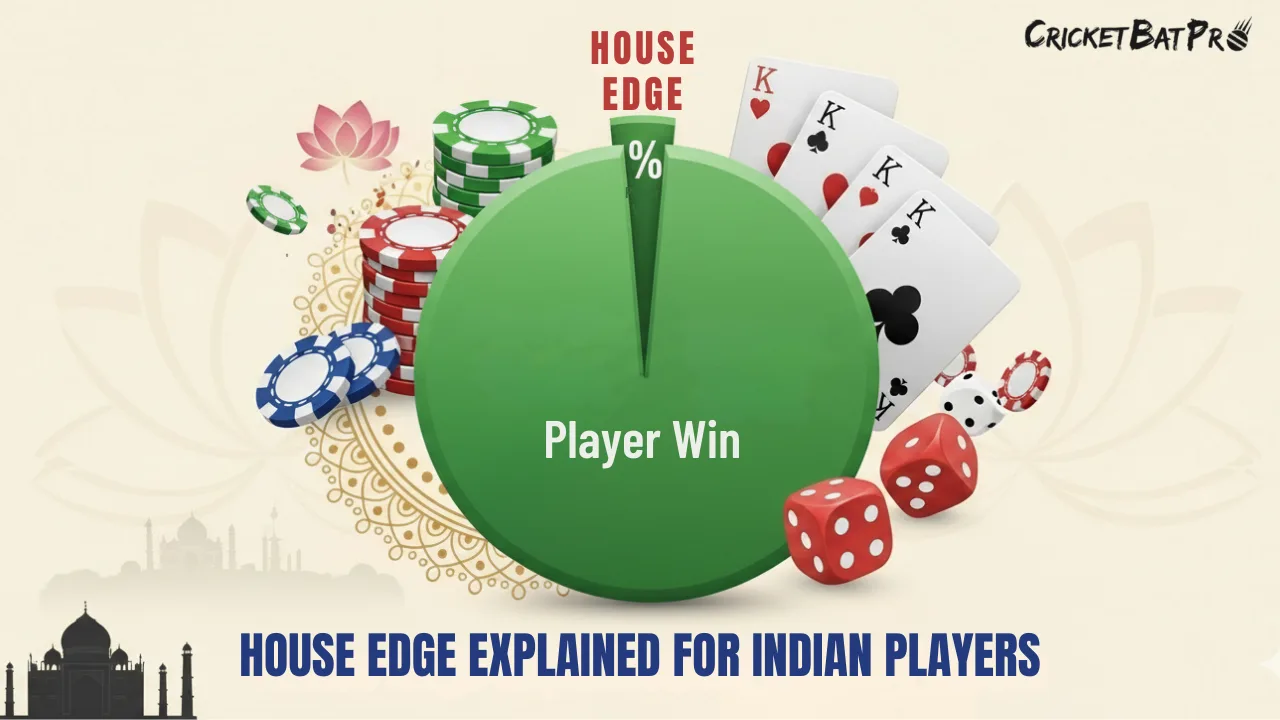
House edge is the mathematical advantage that an online casino has over its players in any game. It is the percentage of each bet that the online casino expects to keep over the long term.
For example, if a game has a house edge of 2%, the casino will keep ₹2 for every ₹100 wagered on average, while the remaining ₹98 is returned to players over time.
However, this does not mean that players lose ₹2 on every ₹100 bet made. The house edge is an average over a long period of time, not individual wagers or short sessions.
House edge applies to all types of casino games which include slots, roulette, blackjack, and baccarat. Games with a lower house edge generally provide better long-term value because more of your total wagering is returned over time.
House Edge vs RTP
House edge and RTP are closely related but represent the game’s expected return from opposite perspectives. The Return to Player represents a percentage of how much a player wins over a period of time and the House Edge represents the percentage the online casino gets to keep over a period of time.
For example, a game with an RTP of 97% has a house edge of 3%, meaning the casino retains ₹3 for every ₹100 wagered in the long run.
Both metrics are based on the same mathematical model and always add up to 100%. RTP is more commonly used when describing slot games, whereas house edge is typically used for table games such as blackjack, baccarat, and roulette.
House Edge by Casino Game
The house edge varies significantly between different casino games. Choosing games with a lower house edge can help extend playtime and reduce the long-term cost of wagering.
| Game | House Edge |
|---|---|
| Blackjack (basic strategy) | ~0.5% |
| Baccarat (Banker bet) | ~1.06% |
| Baccarat (Player bet) | ~1.24% |
| European Roulette | ~2.7% |
| Slots (average) | 3% – 6% |
| American Roulette | ~5.26% |
| Keno | 8% – 20% |
Table games generally offer a lower house edge than most slots, especially when basic strategy is used in blackjack and optimal bets are chosen in baccarat.
Slots have a wider range because each game is configured with a different RTP, which directly affects the house edge.
Why Does House Edge Matter?
House edge determines how quickly your bankroll decreases over time. Games with a lower house edge allow longer play sessions because a smaller percentage of each wager is retained by the casino.
For example, if you play with ₹1,000 on a game with a 1% house edge, the expected long-term cost is ₹10. On a game with a 5% house edge, the expected cost increases to ₹50 for the same amount wagered.
This is why choosing lower house edge games can help extend gameplay and provide better value over time.
Low House Edge vs High House Edge Games
Games with a low house edge return a higher percentage of total wagers to players over time and allow longer sessions to play more compared to those with a higher house edge. Table games such as blackjack and baccarat are commonly preferred for this reason when basic strategy or optimal bets are used.
High house edge games retain a larger portion of each wager, which reduces the bankroll faster. Games like keno and American roulette fall into this category due to their higher built-in casino advantage.
Understanding this difference helps players choose games that match their preferred session length and playing style. Those who are feeling more risky prefer games with a higher house edge.
How to Use House Edge When Choosing Games: Expert Advice
House edge should be used as a comparison tool when selecting between similar games. Choosing options with a lower house edge can help extend playtime and reduce the long-term cost of wagering.
For example, European roulette has a lower house edge than American roulette due to the single zero, and blackjack offers one of the lowest house edges when basic strategy is followed. In baccarat, the banker bet provides a better long-term return than the player or tie bets
Comparing the house edge between games allows players to make more informed decisions without changing their overall playing style.
Common House Edge Myths
House edge is often misunderstood, leading to incorrect assumptions about how casino games work. These common myths can make players overestimate their chances or misunderstand how long-term probabilities apply to real sessions. The myths on house edge are similar to those of the RTP.
- A game is “due” to pay after losses
Each round is independent, and previous results do not change the house edge or future outcomes. - Lower house edge guarantees profit
A lower house edge only reduces the long-term cost of play but the short-term results are still random. - All roulette games have the same house edge
European roulette has a lower house edge than American roulette because it has one fewer zero. - Slots with similar themes have the same house edge
Each slot has its own RTP setting, which determines its house edge
FAQ
Q: What is a good house edge in casino games?
A house edge below 2% is generally considered low and offers better long-term value compared to higher-edge games.
Q: Does house edge affect short sessions?
House edge works over the long run only. Short sessions are influenced more by randomness than the expected percentage.
Q: Which casino games have the lowest house edge?
Blackjack with basic strategy and the banker bet in baccarat typically offer the lowest house edge.

Mehar – Senior Reviewer & Sports Betting Content Specialist
Mehar is a seasoned reviewer and content specialist at Cricket Bat Pro who officially join us in 2023 , dedicated to tracking the latest developments and trends across the global sports industry. With over ten years working in sports media and online betting editorials, Mehar has built a reputation for expert analysis and clear, trustworthy guidance for readers interested in sports betting at large.
Drawing from her experience at respected platforms like BettingExpert, SportsbookReview, and SBC News, Mehar brings sharp insights into bookmaker reliability, odds comparison, and innovative wagering technologies. She specializes in evaluating new sports betting sites, live betting features, and market movements, helping users navigate the fast-changing landscape with confidence.
Mehar is passionate about exploring sports analytics, attending cricket and football matches, and sharing strategic betting tips on social media. She’s an enthusiastic fantasy cricket player and enjoys running sports prediction leagues for friends and community members. Outside of work, Mehar practices yoga, travels to major sporting events, and mentors newcomers through responsible betting initiatives.
Her expertise ensures Cricket Bat Pro’s content remains accurate, up-to-date, and relevant for sports fans and bettors alike.
Relevant news

Casino Says Deposit Address Has Changed: Is This a Scam?
You open your casino cashier to make a deposit. You notice the Bitcoin address shown…

What Happens to My Personal Documents If a Casino Gets Blocked in India?
The question almost every Indian casino player should be asking is the one most are…

NEFT vs IMPS vs UPI for Casino Withdrawals: Which Actually Works in India Now?
You deposited money without any trouble. The casino accepted your UPI payment in under a…

Casino Changed Its Withdrawal Terms After I Deposited: Is That Legal?
The question sounds like it should have a simple answer. It does not, the honest…

I Withdrew Casino Winnings in USDT: How Do I Convert to INR Without Trouble?
USDT has become the default withdrawal method for Indian casino players who can no longer…

Sent Bitcoin to Casino But Deposit Not Showing: How Long Should It Take?
You sent Bitcoin to your casino. Your wallet shows the transaction as complete. The casino…


